
Guide for therapists
Documenting couples and family sessions: whose record, what goes where, and privacy between partners
Updated 28 October 2026
Decide at the start who the client is: the couple or family as a unit, or each person. That choice decides whose record a joint session belongs to, who may read it, and what happens to it if the relationship ends. Write joint notes so that every person in the room could read them, keep what one person shares alone in that person’s own file, and agree a policy on secrets before anyone tells you one. Who can access a shared record, and on what terms, depends on where you practise.
Whose record is it?
| Aspect | One shared record | A record for each person |
|---|---|---|
| Joint sessions | One note in the shared record | The same joint note in each person’s file |
| Individual sessions | Need a separate record, or careful handling | Stay in that person’s file only |
| If the couple separates | The shared record has to be divided or kept as it is | Each person keeps their own file |
| Release of records | Usually involves everyone in it | Joint notes still name the other person |
Either can work. What matters is that you choose deliberately, explain the choice at intake, and keep to it. Write it in each person’s consent, along with who may ask for a copy of a joint note.
What goes in a joint note, and what does not
- Who was present, by name and role, and anyone who left part way through.
- The relationship as the focus: patterns between people, what each person said and how the others responded, kept factual and attributed.
- Balanced language. Describe each person with the same care, so no one reads the note as taking sides.
- Risk asked about for each person, and where that was done privately, a note that it was done and where the detail is kept.
- Not in the joint note: what one person told you alone, their individual history, or a diagnosis for one person that the others have not heard. That belongs in the individual file.
In family work with children, record who holds decision-making responsibility and who consented, and write about each child as carefully as about the adults. Who may read a child’s record depends on where you practise.
Privacy between partners
Set a policy on secrets before individual contact begins, put it in writing, and repeat it when you meet anyone alone. Common positions:
- No secrets: anything said individually that bears on the relationship may be brought into joint sessions, usually by the person themselves with your support.
- Limited secrets: individual disclosures stay private unless they bear on safety or make the joint work impossible.
- Your discretion, explained in advance, with what you would weigh.
Whatever you choose, safety comes first. Questions about violence or coercion between partners are best asked of each person alone, and what is said must not be put where the other partner could read it.
How Olive Grove helps
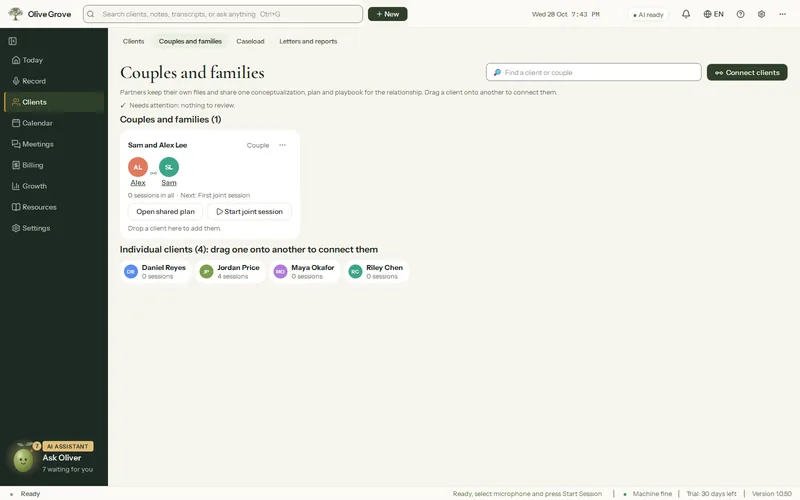
In Olive Grove you connect clients as a couple or family by dragging one onto another. A joint session then appears in every member’s file with one shared note, while a partner’s individual sessions stay in their own file only. The group has a shared relationship formulation and plan, and each person keeps an individual formulation. Ticking who is In the room decides whether a session is joint or individual and which files it goes into. The CSI-4 and the HITS are given to each partner separately. Separate keeps joint sessions in both files and copies the shared formulation and goals to each.
See Couples and families, the couples and family features, and the couples note format in DAP, SOAP, BIRP and GIRP notes.
Common questions
Sources
- Margolin G (1982). Ethical and legal considerations in marital and family therapy. American Psychologist, 37(7), 788-801. doi.org/10.1037/0003-066X.37.7.788
This guide is general information for clinicians, not legal or clinical advice about a particular client. What applies to you depends on where you practise and on your regulator or professional body.
More guides
- DAP, SOAP, BIRP and GIRP notes: the formats, with examples
What each progress note format means, when to use it, and a short example of each: DAP, SOAP, BIRP and GIRP, plus intake and couples notes, for therapists and counsellors.
- Private AI for therapy notes: what “local” means, and what to ask any AI scribe
How AI note tools for therapists handle session audio, where the AI runs, cloud versus on-your-computer AI, and ten questions to ask any AI scribe before you record a client.
- Consent to record therapy sessions: what to explain, how to ask, how to keep the answer
How to ask a client for informed consent to record a therapy session: what to explain, how to ask, how to note the answer, and what to do when consent is withdrawn.
- Measurement-based care with the PHQ-9 and GAD-7: what they measure, how often, and how to read change
Measurement-based care with the PHQ-9 and GAD-7: what each measures, the score bands from the original papers, how often to give them, and how to read change over time.
- Writing a treatment plan with measurable goals: goals, objectives, interventions and review dates
How to write a therapy treatment plan with measurable goals: goals in the client’s words, objectives you can check, the interventions that serve them, and review dates, with an example.
- Keeping client records safe on your own computer: sign-in, encryption, backups and lost devices
Good practice for therapists who keep client records on their own computer: sign-in and screen lock, disk encryption, backups including off-site, and what to do if a device is lost or stolen.
- Using AI for clinical documentation responsibly: a checklist for therapists
A checklist for therapists using AI to draft clinical notes: client consent, where the data goes, reviewing every line, bias, and why the clinician signs.