
Guide for therapists
Measurement-based care with the PHQ-9 and GAD-7: what they measure, how often, and how to read change
Updated 28 October 2026
Measurement-based care means giving a short, validated questionnaire routinely, before or during sessions, looking at the score with the client, and using it to decide whether to keep going or change course. The PHQ-9 measures how severe depression symptoms have been over the past two weeks (0 to 27); the GAD-7 does the same for anxiety (0 to 21). Read change against the client’s own starting point, look for a trend over several sessions rather than one score, and treat every score as one piece of information beside your clinical judgement.
What the PHQ-9 and GAD-7 measure
Both are short self-report questionnaires about the past two weeks. Each item is scored from 0 (not at all) to 3 (nearly every day), and the item scores are added up. The bands below are the ones reported in the original validation papers.
| Aspect | PHQ-9 | GAD-7 |
|---|---|---|
| Measures | Depression severity: the nine depression criteria of the diagnostic manual of the time | Generalised anxiety severity |
| Range | 0 to 27 | 0 to 21 |
| Bands | 5 mild, 10 moderate, 15 moderately severe, 20 severe | 5 mild, 10 moderate, 15 severe |
| As a screen | 10 or more: 88% sensitivity and 88% specificity for major depression | 10 or more: 89% sensitivity and 82% specificity for generalised anxiety disorder |
| Validated in | 6,000 primary care and obstetrics and gynaecology patients | 2,740 primary care patients |
- A score is not a diagnosis. A high score says a clinical assessment is worth doing; it does not replace one.
- PHQ-9 item 9 asks about thoughts of being better off dead or of self-harm. Any answer above 0 calls for a follow-up risk assessment by you, whatever the total.
- Use a version in the client’s language that has been translated and checked, rather than translating on the spot.
How often to give them
Lewis and colleagues define measurement-based care as the systematic evaluation of symptoms before or during an encounter to inform treatment, and report that it is used by fewer than one in five behavioural health practitioners. They list the best timing as an open research question. In practice, clinicians tend to choose one of these rhythms and keep to it:
- At intake, to set a starting point.
- Every session, or every few sessions, while the work is active. A rhythm the client can count on matters more than the exact interval.
- At reviews of the treatment plan, so the goals and the scores are read together.
- At the end of care, to see where the client finished.
Give the score back. Showing the client their own trend, and asking whether it matches how they feel, is part of the method, and it is often where the useful conversation starts.
How to read change
- Compare with the client’s own starting point, not with other clients.
- Look for a trend across several scores. One higher week after a hard event says less than three sessions moving the same way.
- Ask whether the change is bigger than the measure’s own noise. Jacobson and Truax proposed the reliable change index for this: a change counts as reliable when it is larger than measurement error alone would explain.
- Ask whether it is clinically significant. In the same paper, that means the client has moved out of the range typical of people seeking help and towards the range typical of people who are not.
- When scores stall or worsen, treat it as a prompt to review the plan with the client, and with supervision or consultation where that helps.
How Olive Grove helps
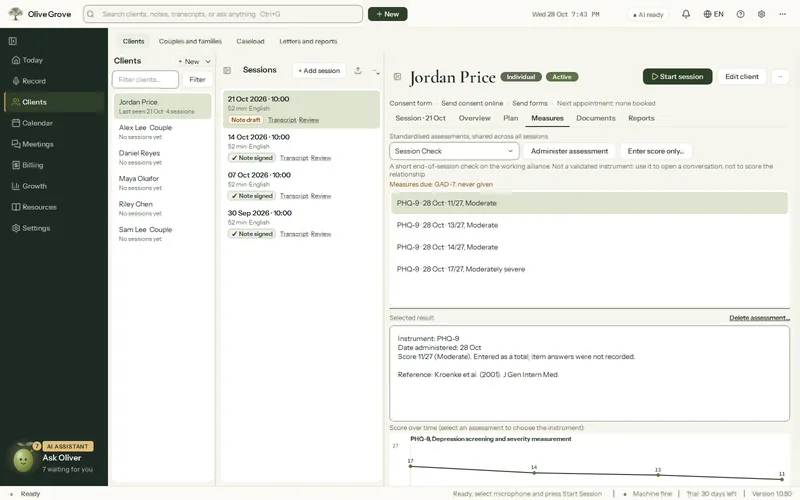
Olive Grove has 13 questionnaires built in, the PHQ-9 and GAD-7 among them, scored with their severity as you fill them in, in the session or from the client’s file. Every result is kept, and Score over time draws the trend. The PHQ-9 and GAD-7 are prompted again every 4 sessions by default, a rhythm you can change, and item 9 of the PHQ-9 opens a safety review that asks you to confirm the action you took. Clients can also answer the PHQ-9 or GAD-7 online before their first session.
See Give a questionnaire and track scores, Measures due and safety flags, The 13 measures and how they are scored and Clients and records.
Common questions
Sources
- Kroenke K, Spitzer RL, Williams JBW (2001). The PHQ-9: validity of a brief depression severity measure. Journal of General Internal Medicine, 16(9), 606-613. doi.org/10.1046/j.1525-1497.2001.016009606.x
- Spitzer RL, Kroenke K, Williams JBW, Löwe B (2006). A brief measure for assessing generalized anxiety disorder: the GAD-7. Archives of Internal Medicine, 166(10), 1092-1097. doi.org/10.1001/archinte.166.10.1092
- Lewis CC, Boyd M, Puspitasari A, et al. (2019). Implementing measurement-based care in behavioral health: a review. JAMA Psychiatry, 76(3), 324-335. doi.org/10.1001/jamapsychiatry.2018.3329
- Jacobson NS, Truax P (1991). Clinical significance: a statistical approach to defining meaningful change in psychotherapy research. Journal of Consulting and Clinical Psychology, 59(1), 12-19. doi.org/10.1037/0022-006X.59.1.12
This guide is general information for clinicians, not legal or clinical advice about a particular client. What applies to you depends on where you practise and on your regulator or professional body.
More guides
- DAP, SOAP, BIRP and GIRP notes: the formats, with examples
What each progress note format means, when to use it, and a short example of each: DAP, SOAP, BIRP and GIRP, plus intake and couples notes, for therapists and counsellors.
- Private AI for therapy notes: what “local” means, and what to ask any AI scribe
How AI note tools for therapists handle session audio, where the AI runs, cloud versus on-your-computer AI, and ten questions to ask any AI scribe before you record a client.
- Consent to record therapy sessions: what to explain, how to ask, how to keep the answer
How to ask a client for informed consent to record a therapy session: what to explain, how to ask, how to note the answer, and what to do when consent is withdrawn.
- Documenting couples and family sessions: whose record, what goes where, and privacy between partners
How to document couples and family therapy: whose record it is, what goes in a joint note and what stays in an individual file, and privacy between partners.
- Writing a treatment plan with measurable goals: goals, objectives, interventions and review dates
How to write a therapy treatment plan with measurable goals: goals in the client’s words, objectives you can check, the interventions that serve them, and review dates, with an example.
- Keeping client records safe on your own computer: sign-in, encryption, backups and lost devices
Good practice for therapists who keep client records on their own computer: sign-in and screen lock, disk encryption, backups including off-site, and what to do if a device is lost or stolen.
- Using AI for clinical documentation responsibly: a checklist for therapists
A checklist for therapists using AI to draft clinical notes: client consent, where the data goes, reviewing every line, bias, and why the clinician signs.