
Guide for therapists
Writing a treatment plan with measurable goals: goals, objectives, interventions and review dates
Updated 28 October 2026
A useful treatment plan links four things: a goal the client cares about, in their words; objectives that show progress towards it and can be checked; the interventions you will use; and a date to review it. Make each objective specific and measurable, with a way to tell whether it has been met, such as a score, a count or an observable behaviour. Write the plan with the client, review it on the dates you set, and change it when the work changes.
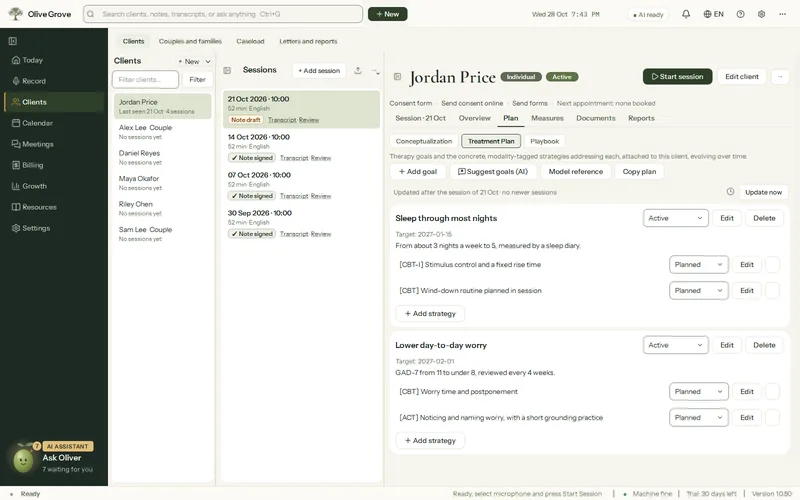
The parts of a treatment plan
- The problem or need, briefly, as you and the client understand it.
- Goals: what the client wants to be different, in their own words. Broad is fine here.
- Objectives: the steps that show progress towards a goal, each specific, measurable and dated.
- Interventions: what you will do in sessions, and what the client will practise between them.
- Measures: how progress will be checked, such as a questionnaire, a diary or a count.
- Review dates, and who was involved in writing the plan.
Making goals measurable
The SMART checklist, first set out for management goals, is a practical test for each objective: is it specific, measurable, achievable, relevant to the goal, and time-bound? An objective passes when you and the client would agree, on the review date, whether it was met.
| Vague | Measurable |
|---|---|
| Reduce anxiety | GAD-7 below 10 on two scores in a row by the review date |
| Improve sleep | Asleep within 30 minutes on 5 nights out of 7, from the sleep diary |
| Communicate better as a couple | Use the agreed time-out at least once in each argument over the next month, by both partners’ report |
Goal attainment scaling, from Kiresuk and Sherman, adds a scale to each goal before treatment starts, from much less than expected (minus 2) through the expected outcome (0) to much more than expected (plus 2). It suits goals that no standard questionnaire captures.
An example plan
- Goal
- “To get through work meetings without leaving the room.”
- Objective 1
- Stay in a weekly team meeting until the urge to leave falls, in 3 of 4 meetings, within 8 weeks
- Objective 2
- GAD-7 from 14 at intake to below 10 on two scores in a row
- Interventions
- Psychoeducation on panic; paced breathing; a graded exposure ladder for meetings, built together
- Measures
- GAD-7 every few sessions; a meeting log kept by the client
- Review
- At session 8, or sooner if scores worsen
Reviewing the plan
- Review on the dates you set, with the client, and write down what was decided.
- For each objective, record met, partly met or not met, with the evidence: the scores, the log, what the client reports.
- Change the plan when the work changes: a new goal, an objective that no longer fits, an intervention that is not helping.
- Link session notes to the plan, so each note says which goal the session served. Goal-based formats such as GIRP make that easy.
How Olive Grove helps
In Olive Grove, each client has a treatment plan of goals, each with a priority, a target date and a status (Active, Achieved, On hold, Discontinued), and strategies under each goal tagged by approach. Suggest goals (AI) drafts goals for you to accept or untick; nothing is added to the plan on its own, and updates from sessions are suggestions for you to review. Homework set in a note’s plan is followed up at the next session, and the questionnaires and their trends sit in the same file.
See Treatment plans, formulations and playbooks, Clients and records, and Measurement-based care with the PHQ-9 and GAD-7.
Common questions
Sources
- Kiresuk TJ, Sherman RE (1968). Goal attainment scaling: a general method for evaluating comprehensive community mental health programs. Community Mental Health Journal, 4(6), 443-453. doi.org/10.1007/BF01530764
- Doran GT (1981). There’s a S.M.A.R.T. way to write management’s goals and objectives. Management Review, 70(11), 35-36.
This guide is general information for clinicians, not legal or clinical advice about a particular client. What applies to you depends on where you practise and on your regulator or professional body.
More guides
- DAP, SOAP, BIRP and GIRP notes: the formats, with examples
What each progress note format means, when to use it, and a short example of each: DAP, SOAP, BIRP and GIRP, plus intake and couples notes, for therapists and counsellors.
- Private AI for therapy notes: what “local” means, and what to ask any AI scribe
How AI note tools for therapists handle session audio, where the AI runs, cloud versus on-your-computer AI, and ten questions to ask any AI scribe before you record a client.
- Consent to record therapy sessions: what to explain, how to ask, how to keep the answer
How to ask a client for informed consent to record a therapy session: what to explain, how to ask, how to note the answer, and what to do when consent is withdrawn.
- Measurement-based care with the PHQ-9 and GAD-7: what they measure, how often, and how to read change
Measurement-based care with the PHQ-9 and GAD-7: what each measures, the score bands from the original papers, how often to give them, and how to read change over time.
- Documenting couples and family sessions: whose record, what goes where, and privacy between partners
How to document couples and family therapy: whose record it is, what goes in a joint note and what stays in an individual file, and privacy between partners.
- Keeping client records safe on your own computer: sign-in, encryption, backups and lost devices
Good practice for therapists who keep client records on their own computer: sign-in and screen lock, disk encryption, backups including off-site, and what to do if a device is lost or stolen.
- Using AI for clinical documentation responsibly: a checklist for therapists
A checklist for therapists using AI to draft clinical notes: client consent, where the data goes, reviewing every line, bias, and why the clinician signs.