
Guide for therapists
Using AI for clinical documentation responsibly: a checklist for therapists
Updated 28 October 2026
AI can draft a clinical note, but the note is still yours: you decide what it says, you check every line against what happened, and you sign it. Use AI only with the client’s informed consent, with a tool whose handling of data you have checked, and with the habit of reading each draft as if someone who was not in the room wrote it. Watch for statements the session does not support, for missing risk, and for wording that carries bias. The checklist below works for any tool.
The checklist
- Consent: the client knows AI is used, what it does, where their information goes, and that they can say no without any change to their care.
- Where the data goes: you know whether audio and transcripts stay on your computer or go to a company, which company, for how long, and whether they are used to train a model.
- Every line reviewed: nothing is signed until you have read it all against your memory of the session.
- Nothing the session did not support: no diagnosis, severity or risk wording that was not said or assessed; no invented quotes, dates or history.
- Nothing important missing: risk asked about and the answer, consent, safety plans and anything unusual are in the note.
- Bias checked: language about culture, gender, disability, class or religion is accurate, respectful and the client’s own where possible.
- Your voice and judgement: the assessment and plan are yours, not a summary the tool chose.
- You sign: the note is signed by you, and corrections after signing keep the earlier version.
- Your rules: you have checked what your regulator or professional body says about AI and recording where you practise.
Reviewing a draft well
Language models write fluently, and fluent text is easy to trust. The World Health Organization’s guidance on large multi-modal models names automation bias, the habit of accepting what a system produces without enough scrutiny, as a risk for health professionals. A few habits keep the review honest:
- Review soon after the session, while you still remember it.
- Check every quote, number, name and date against the transcript or your memory.
- Read the assessment and plan slowly: they are where an unsupported conclusion does the most harm.
- Delete what you would not have written yourself.
Bias
AI systems learn from data that carries the patterns of the world that made it. In a widely cited study, Obermeyer and colleagues found that an algorithm used to manage the care of millions of patients underestimated the needs of one group, because it predicted health costs rather than illness. A note-writing model can do something similar on a small scale: describing the same behaviour differently depending on who the client is. Read for it, and correct it.
How Olive Grove helps
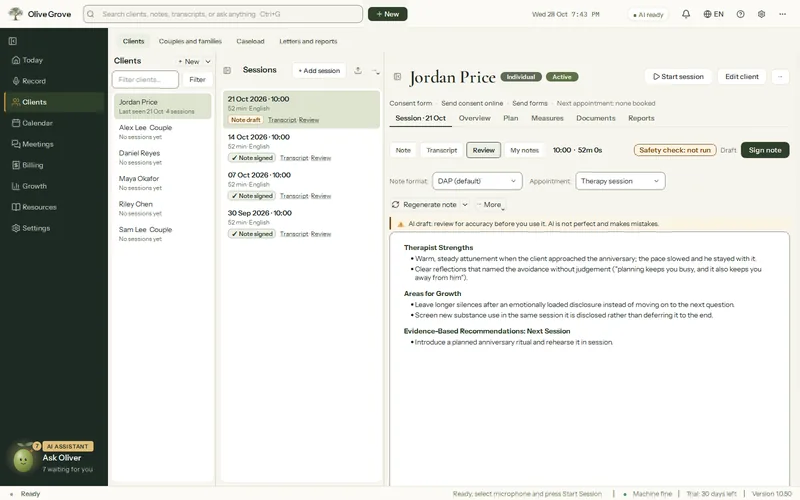
In Olive Grove, speech recognition and the AI that drafts notes run on your computer, and there is no online AI provider. Every draft is marked as an AI draft. The review bar counts Risk, Conflicts, Unsupported and Missing items; Show sources puts beside any sentence the transcript lines it most likely came from; and a second pass flags risk the note missed and statements the transcript does not support, without changing the note. Sign note asks you to confirm you have read it and it is accurate, and a signed note is locked: Unlock to amend keeps the signed version and records why. Check my notes looks across your notes for diagnosis, severity or risk wording the session never used.
See Review, correct and sign a draft note, Check and fix your notes in bulk, Notes, Where the data goes and Private AI for therapy notes.
Common questions
Sources
- World Health Organization (2021). Ethics and governance of artificial intelligence for health: WHO guidance. ISBN 9789240029200. www.who.int/publications/i/item/9789240029200
- World Health Organization (2024). Ethics and governance of artificial intelligence for health: Guidance on large multi-modal models. ISBN 9789240084759. www.who.int/publications/i/item/9789240084759
- Obermeyer Z, Powers B, Vogeli C, Mullainathan S (2019). Dissecting racial bias in an algorithm used to manage the health of populations. Science, 366(6464), 447-453. doi.org/10.1126/science.aax2342
This guide is general information for clinicians, not legal or clinical advice about a particular client. What applies to you depends on where you practise and on your regulator or professional body.
More guides
- DAP, SOAP, BIRP and GIRP notes: the formats, with examples
What each progress note format means, when to use it, and a short example of each: DAP, SOAP, BIRP and GIRP, plus intake and couples notes, for therapists and counsellors.
- Private AI for therapy notes: what “local” means, and what to ask any AI scribe
How AI note tools for therapists handle session audio, where the AI runs, cloud versus on-your-computer AI, and ten questions to ask any AI scribe before you record a client.
- Consent to record therapy sessions: what to explain, how to ask, how to keep the answer
How to ask a client for informed consent to record a therapy session: what to explain, how to ask, how to note the answer, and what to do when consent is withdrawn.
- Measurement-based care with the PHQ-9 and GAD-7: what they measure, how often, and how to read change
Measurement-based care with the PHQ-9 and GAD-7: what each measures, the score bands from the original papers, how often to give them, and how to read change over time.
- Documenting couples and family sessions: whose record, what goes where, and privacy between partners
How to document couples and family therapy: whose record it is, what goes in a joint note and what stays in an individual file, and privacy between partners.
- Writing a treatment plan with measurable goals: goals, objectives, interventions and review dates
How to write a therapy treatment plan with measurable goals: goals in the client’s words, objectives you can check, the interventions that serve them, and review dates, with an example.
- Keeping client records safe on your own computer: sign-in, encryption, backups and lost devices
Good practice for therapists who keep client records on their own computer: sign-in and screen lock, disk encryption, backups including off-site, and what to do if a device is lost or stolen.