
Guide for therapists
Consent to record therapy sessions: what to explain, how to ask, how to keep the answer
Updated 28 October 2026
Informed consent to record means the client understands what will be recorded, why, where it goes, who can see it, how long it is kept and how to say no or change their mind, and agrees freely. Ask before the first recorded session, in plain words, with a written copy they can keep. Record their answer and the date in their file, and make it as easy to withdraw as it was to agree. What the law and your professional body require depends on where you practise; this guide covers the practical side.
What to explain before you ask
Consent is only informed when the client knows what they are agreeing to. Cover each of these, in words the client would use:
- What is recorded: audio, video or both, and whether the recording is turned into a transcript.
- Why: for example, so you can write accurate notes and stay present in the session.
- Where it is processed and kept: on your own computer, or on a company’s servers, and in which country.
- Who can see or hear it: you, a supervisor, colleagues, the tool’s provider, anyone else.
- Whether AI is used, what it does (transcribes, drafts a note) and that you check and sign every note yourself.
- How long it is kept, and whether the recording is deleted once the note is written.
- That saying no changes nothing about their care, and that they can stop the recording at any time, including mid-session.
- The limits of confidentiality, which apply to recordings as they do to the rest of the record.
How to ask
- Ask before the session, not at the door. Send the form with the intake paperwork, then go over it together at the start.
- Use plain language and a short form. One page the client can read in a few minutes is better than a long document nobody reads.
- Invite questions, and pause for them. Check understanding by asking the client to say in their own words what will happen to the recording.
- Make no the easy answer. Say plainly that you will take notes by hand instead and that their care is the same either way.
- Ask each person in the room. In couples, family and group work, everyone recorded gives their own consent.
- Offer it in the client’s language, and use an interpreter where needed so the consent is truly understood.
Where a client cannot consent for themselves, for example a young child or an adult who lacks capacity, who may consent on their behalf, and how the client is still involved, depends on where you practise. Check with your regulator or professional body.
How to record the answer
Keep the answer where anyone reading the file would look for it, so there is never doubt about whether a session could be recorded.
- Date
- The day consent was given
- Who
- J.R., in person, form read together
- What
- Audio recording of sessions, transcribed and drafted into notes on the therapist’s computer; recordings deleted after the note is signed
- Answer
- Agreed; asked that sessions about family history not be recorded
- Copy
- Signed form kept in the file; copy given to the client
- Review
- To review in a year, or sooner if anything changes
Note conditions as carefully as the yes itself. A client may agree to audio but not video, or to recording only some sessions. Revisit consent when something changes: a new tool, a new use such as supervision, or a new person in the room.
When a client withdraws consent
- Stop recording at once, including in the middle of a session, without asking for a reason.
- Record the withdrawal with the date and how it was given (spoken, written, by message).
- Talk about what happens to earlier recordings. Explain what you can delete and what must stay in the record where you practise, and act on it.
- Switch to your usual notes and keep the care unchanged. Withdrawal is not a clinical event in itself.
- Ask again only if the client raises it, never as pressure.
How Olive Grove helps
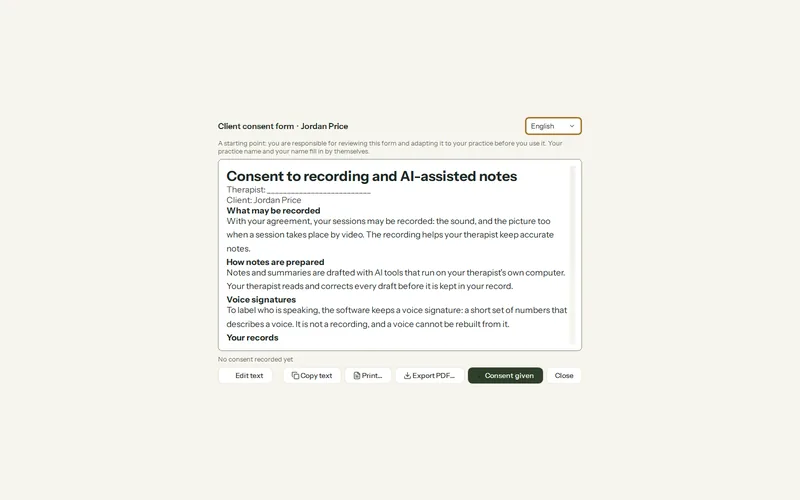
Olive Grove includes a one-page, plain-language consent form with your practice and name filled in. It covers recording, AI-drafted notes on your computer, voice signatures, record keeping, withdrawal and confidentiality, and you can edit it into your own template. One press of Consent given records consent with the date in the client’s care record, which also keeps consent refused or withdrawn and how. The client’s To do says when consent is due for review, every 12 months unless you change it. You can also send the form online: the client signs by typing their name, without an account.
The form is a starting point for you to review and adapt; nothing in the app depends on it. See The consent form and the care record, Forms clients fill in before the first session and Clients and records.
Common questions
Sources
- Beauchamp TL, Childress JF (2019). Principles of Biomedical Ethics, 8th edition. Oxford University Press. ISBN 9780190640873. search.worldcat.org/title/Principles-of-biomedical-ethics/oclc/1236131200
This guide is general information for clinicians, not legal or clinical advice about a particular client. What applies to you depends on where you practise and on your regulator or professional body.
More guides
- DAP, SOAP, BIRP and GIRP notes: the formats, with examples
What each progress note format means, when to use it, and a short example of each: DAP, SOAP, BIRP and GIRP, plus intake and couples notes, for therapists and counsellors.
- Private AI for therapy notes: what “local” means, and what to ask any AI scribe
How AI note tools for therapists handle session audio, where the AI runs, cloud versus on-your-computer AI, and ten questions to ask any AI scribe before you record a client.
- Measurement-based care with the PHQ-9 and GAD-7: what they measure, how often, and how to read change
Measurement-based care with the PHQ-9 and GAD-7: what each measures, the score bands from the original papers, how often to give them, and how to read change over time.
- Documenting couples and family sessions: whose record, what goes where, and privacy between partners
How to document couples and family therapy: whose record it is, what goes in a joint note and what stays in an individual file, and privacy between partners.
- Writing a treatment plan with measurable goals: goals, objectives, interventions and review dates
How to write a therapy treatment plan with measurable goals: goals in the client’s words, objectives you can check, the interventions that serve them, and review dates, with an example.
- Keeping client records safe on your own computer: sign-in, encryption, backups and lost devices
Good practice for therapists who keep client records on their own computer: sign-in and screen lock, disk encryption, backups including off-site, and what to do if a device is lost or stolen.
- Using AI for clinical documentation responsibly: a checklist for therapists
A checklist for therapists using AI to draft clinical notes: client consent, where the data goes, reviewing every line, bias, and why the clinician signs.